
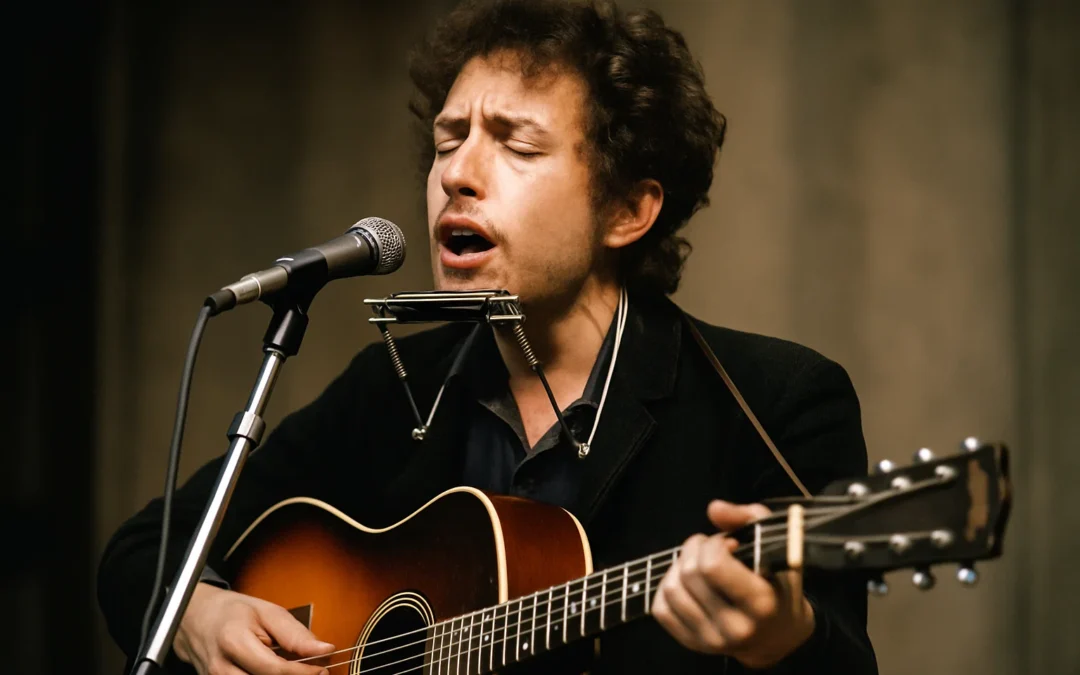
Bob Dylan Keeps Us Knockin’
Years ago, a woman named Monica pleaded with a bishop, Ambrose, for some answers about her wayward son Augustine. He replied, “It is impossible that the son of so many tears should perish.”
I think of this story whenever I hear Bob Dylan’s song, “Knockin’ on Heaven’s Door.” The song was written for a Western flick, and the words are put in the mouth of a dying sheriff. One can hear a few quiet verses in the background, but most of the song is made up of the haunting words, “Knock, knock, knockin’ on heaven’s door.”
It seems that all we hear are those words, repeated again and again, as if they will echo forever. Like Monica’s continuous praying, the sheriff keeps knocking.
For her persistence, Monica eventually witnessed her son’s conversion and baptism. At that point she admitted that her vocation in life had been accomplished; she passed shortly afterwards. She is called a saint today, and her son Augustine became a great Christian scholar and apologist — most likely the most prominent theologian in Christianity.
Knocking and Wanting What?
When you think of a man knocking at the end of life’s journey, what do you think he wants? A heavenly favor? Seeking God in some deep mysterious way?
“Knockin’ on Heaven’s Door” lands hard precisely because Dylan keeps it simple. People load this song with layers of theology or big philosophical statements, but at its core, it’s incredibly simple and human. Dylan wasn’t penning a sermon — he was writing a death scene.
He wrote it for the 1973 film Pat Garrett & Billy the Kid, where a lawman is shot and slowly realizes he’s dying. That’s the backdrop. The lines “Mama, take this badge off of me / I can’t use it anymore” aren’t metaphors about rejecting authority or protesting war; they’re the words of a man letting go of his role and identity in the last minutes of his life. He’s done. The badge, the job, the burdens — he’s leaving that whole world behind.
The chorus—“knock, knock, knockin’ on heaven’s door”—seems to go beyond the poetic toward the hypnotic. It feels like the mental loop of someone drifting out of consciousness, hanging onto one last coherent thought. Dylan leans into minimalism here: just a few repeated lines, four chords, and almost no ornamentation. You can hear surrender in it, not fear. It’s about a man who knows he’s at the end and isn’t fighting it anymore.
It Grew and Grew
What’s odd is that the song became bigger than Dylan ever intended, mostly because listeners kept projecting their own experiences onto it. Its spareness leaves room for interpretation. Over the years the song has been used for:
- funerals
- protests
- spiritual reflections
- anti-war messaging
The song can hold all those meanings because Dylan didn’t force any particular one onto it.
Will the door to heaven open for this man? Will he reach the beatific vision? The continuous knocking implies a yearning and hope that it will.
The scene calls to mind the words in the Bible spoken metaphorically by Jesus Christ, “Behold, I stand at the door and knock; if any one hears my voice and opens the door, I will come in to him and eat with him, and he with me” (Rev. 3:20).
But the Bible quote flips the script. Christ raps at the door, which can occur only while the person is alive. The dying sheriff is banging on the door, maybe asking for mercy at his time of judgment.
The song turns us inward to make us look at what kind of door we’re knocking at while still walking this earth. If we know that we are seeking something outside of ourselves, we are on the right track.
Did you enjoy this article? Why not share it among your friends with the below buttons? Thank you.